- Sat 14 February 2026
- meetups
- Paul Mayero
- #meetups, #meetup, #ilovefreesoftwareday, #kfc
We had our first meetup of the year on the 14th of February 2026 at KFC Kimathi Street. The place was full. After all, it was Valentine's day I love Free Software day and people were definitely celebrating it.
The thrill of having a meetup in a public restaurant from an invite posted on the internet is similar to that of having a blind date. You just can't tell who will show up. And that is the fun part, waiting to be suprised . :)
The meetup was attended by 5 people. The 6th came in way later after it was over. Better late than never, right? The very first few minutes were spent by people introducing themselves and mentioning how they were involved in FLOSS. Then we got right into the meat of it.
AI and its impact on life as we know it
AI is here. It is already part of our daily lives. Everyone in attendance agreed with this. A concern was that if and when AI becomes largely adopted by businesses and organizations, how work is done will change completely. The total effect on jobs is unclear and it would depend on how AI is utilized. There were thoughts that there would be no need for employees as knowledge workers anymore. This was supported by the recent wave of layoffs in many companies because of its potential. The takeaway was that real impact can't be known since new roles are also being created as others are being rendered obsolete. We just have to wait until the AI adoption cycle fully plays out. Various publications have done vast research on this topic. Read their findings below:
- MIT Management Sloan School Report on AI impact on US labour market
- Federal Reserve bank of St. Louis Report on the impact of Generative AI on work productivity
- National Bureau Of Economic Research Working Paper on AI
AI development and research is still in its infancy. More time and research is needed before fully autonomous AI agents are created. This gives knowledge workers an advantage in that, current adoption at this time would be under the supervision of experienced knowledge workers who understand the business and processes. In this case, AI agents can be trained similar to how a senior colleague mentors a junior. This wouldn't mean that inexperienced knowledge workers would not be hired. Actually it would be quite the opposite, they definitley would be hired as a resource to keep the AI agents in check. Various companies are employing this strategy as seen in IBM's case of hiring more junior developers.
Once AI adoption is mature, it will be like any other tool that makes work easier and faster. This will be the case especially for work and tasks that require high levels of skill and precision. A good example is of how design software enables draftsmen to produce blue prints easier and faster than if they did the drawings manually.
Overdependence on AI will make knowledge workers incompetent. With the current capability of generative AI, these models are used even for the most trivial of tasks. It seems knowledge workers are disincentivized from applying themselves in their work. For instance, there are cases of software engineers using AI agents for task completion in their work. It is understandable given that AI agents can generate code in mere seconds. Similar code that it would take an experienced engineer minutes to an hour. However, the capability of these engineers to solve problems creatively becomes diminished as their creative muscles are not being exercised accordingly.
Generative AI can be used for crime. A simple case scenario that resonated with everyone in the group was how M-Pesa payment messages could be generated and shown to unsuspecting attendants. Many establishments only ask for the transaction code and time of payment rather than verifying the actual payment. There have been rumours that a student in JKUAT has been eating for free in the various hotels in Juja by using this trick.
With regards to open-source software, AI has a good case in helping out with contributions. It would ease the burden on maintainers and lower the barrier of contribution on new contributors. The challenge is that most popular AI models are proprietary. This means that the contributions they make might not be in alignment with the licenses of open-source software. Such contributions are likely not to be merged when submitted upstream. This is evident from the case of a contributor who used AI to submit code to the Numpy codebase. At this time,various open-source projects are coming up with AI policies. Some projects are explicitly against using AI for contributions. The Gentoo Project is a good example of this and has it stated in its AI policy. The Fedora Project has a more lax approach and actually allows contributors to use AI when making contributions as long as it meets a spcific set of criteria as explained in its AI policy. The Debian Project doesn't have an AI policy in place at the time of writing. They are currently discussing it. You can follow this discussion on the mailing list.
Merchandise
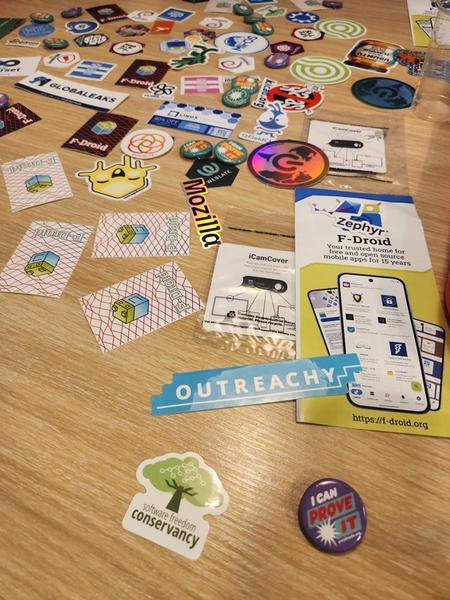
Once the meetup was over, the attendees got some merch. See pics below. :)

Cool video we have on how to install OpenClaw on Linux
One of the members of the LUG - ekiara - shared this video with us. Enjoy it. Interview with 'Just use a VPS bro' (Openclaw edition)
Join our chat and share a video that you think is funny. We might have it featured in our next blog. :)
March Meetup
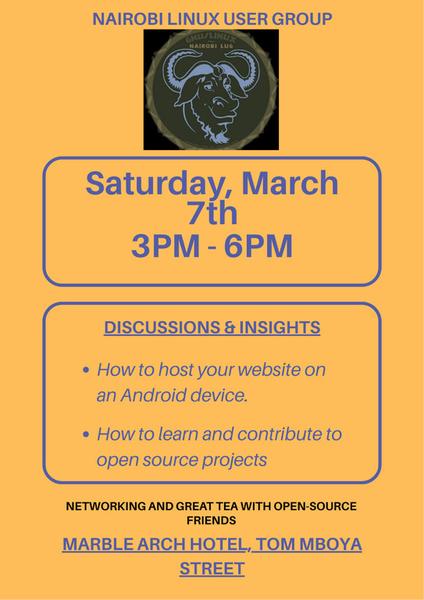
Remember, we meet on the first Saturday of the month. See you on the 7th of March at 1500 EAT.
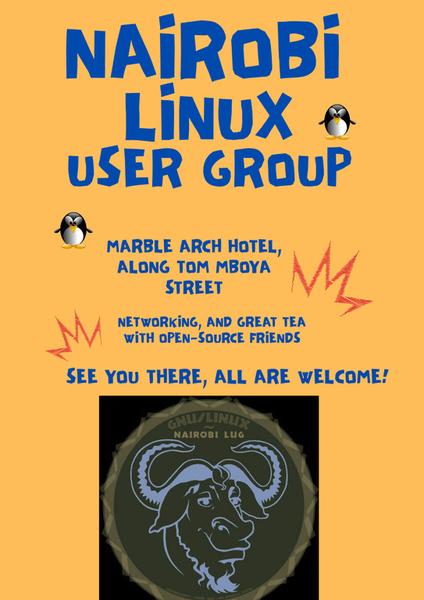
We'll be meeting at Marble Arch Hotel on Lagos Rd, Off Tom Mboya Street from 3 to 6 pm.
See you there!
Check out the cool posters that Cornelius made for the next meetup below.